
“Asking What the Church Truly Is”… U.S. Church Grew ‘From Faith Community to Nation,’ Korean Church ‘From Bible Study to Church’
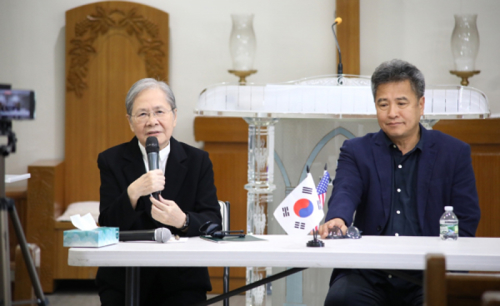
A public forum titled “Seeking the Essence of the Church” was held on the 25th at Queens Central United Methodist Church under the sponsorship of the Paul World Mission Society, led by the Rev. Young-sook Han.
Held under the theme “A Historical Comparison of the Korean and American Churches,” the forum went beyond simply reviewing the histories of the churches in the two countries. Instead, participants examined the spiritual convictions and foundations from which they emerged and asked how faithfully churches today have preserved those original foundations.
In the case of the American church, speakers emphasized how communities first formed around religious purpose and covenant and later developed into broader social and national communities. In discussing Korean Christianity, the forum presented the view that its history should not be explained solely by the arrival of foreign missionaries, but should also recognize Koreans who actively sought new ideas, studied Scripture for themselves and came to embrace the Christian faith.
The two different historical paths ultimately converged on one question: What has the church today lost, and what must it recover?
For the American church, the discussion examined how a powerful sense of purpose that once helped shape communities and society could be transformed amid prosperity and success. For the Korean church, participants considered how its early tradition of independently studying Scripture has been maintained—or weakened—in a church culture increasingly focused on outward growth and numbers.
“What Is the Church in the Age of AI?” Finding Its Essence in the Gospel of John
The forum opened with the singing of the Korean national anthem, followed by an opening prayer from the Rev. Yo-seop Lee, senior pastor of Queens Central United Methodist Church.
Before the historical presentations began, the Rev. Young-sook Han delivered a message titled “The Essence of the Church According to the Gospel of John,” based on John 1:14, providing a theological framework for the discussion.
Han began by describing a recent encounter with the expression “Page Church.” She had come across a person who posted one page of personal reflections or meditations online each day and called it a “church.” The experience led her to reconsider what can truly be called a church in an age of artificial intelligence and robotics.
“The form of the church may differ depending on the age and the people,” Han said. “But Scripture is our text, while everything else is context that changes according to circumstances. We therefore have to ask again what Scripture itself says the church is.”
She noted in particular that the Greek word ekklesia, commonly translated as “church,” does not appear in the Gospel of John. The term appears directly in the writings of the Apostle Paul and in the Gospel of Matthew, yet John, which was written at a time when multiple churches were already in existence, does not use the word.
“When people heard the word ‘church’ even in those days, they probably already imagined a particular kind of religious organization,” Han said. “Perhaps John did not use the term because he did not want the church to be reduced to merely one religious group among many.”
Instead, Han pointed to John 1:14—“The Word became flesh and made his dwelling among us”—as a key to understanding the essence of the church.
“The Word is Jesus Christ, and the church is Jesus Christ made visible in this world,” she said. “The church belongs not to the world but to God. Whether a church is large or small, or whether it has a building or not, has nothing to do with its essence.”
Han also connected the “glory” described in John’s Gospel with the resurrection.
“There is nothing humanity fears more than death, but Jesus Christ overcame death,” she said. “The church is where the life of the resurrection that conquered death is proclaimed. Without that, the church has no reason to exist.”
She also pointed to the phrase “full of grace and truth” as another essential description of the church.
“Grace is the grace of Jesus Christ, who died on the cross for sinners. In other words, it is the love of God that forgives sinners,” Han said. “The church is where we experience that I am someone who has been forgiven and you are someone who has been forgiven, and where that love is expressed through forgiving one another.”
Ultimately, she said, the essence of the church can only be seen through the eyes of faith.
“When we lose the eyes of faith and begin doing everything through human methods, human means and human thinking, the essence of the church becomes invisible,” she said. “The church does not become salt and light because of something it does. The church is salt and light by virtue of what it is.”
“Preserving and recovering this essence of the church is the most important work we have to do,” she added.
That question became the framework for the remainder of the forum as participants examined the histories of the American and Korean churches and considered their present condition.
“Purpose Came Before Territory”… How a Faith Community Grew Into Society and Nation
Professor Gil-joo Lee, a scholar of American history, described the central pattern of early American history as a progression from “faith community to social community to national community.”
Lee first described the ordinary development of a human community as a sequence of “land, people, production, ownership, purpose and continuity.”
People settle on land, he explained, begin producing and owning property, and eventually develop a shared purpose and a desire to preserve the community for future generations.
Historically, however, communities that prioritized territory and ownership often produced conflict and war, Lee said. Violence and exclusion could also emerge when communities attempted to determine who belonged within a particular territory.
According to Lee, the Pilgrims and Puritans who crossed the Atlantic to North America in the 17th century reversed that order.
“In the early 1600s, people appeared who completely turned this sequence around,” Lee said. “They established the purpose first. They believed that the birth of a community had to begin with a purpose, and that the purpose had to possess a permanence that would extend beyond a single generation.”
“People who believed in that purpose then formed a community, and only after that came land, production and ownership,” he continued. “A faith community was formed first. A social community was built upon that faith community, and that social community eventually expanded into a national community.”
Lee also distinguished between the Pilgrims and the Puritans.
The Pilgrims believed a complete break with the Church of England was necessary, while the Puritans continued to see the possibility of reform within the established church. Both groups, however, shared the conviction that religious purpose came first and that people sharing that purpose should form a community together.
“The Pilgrims believed that if the salvation they sought was not possible through the Church of England, they had to cut themselves off from it,” Lee said. “The Puritans believed they could still fulfill their purpose and calling within the Church of England.”
“Although there were differences, they shared the conviction that people with the same purpose and convictions should walk together toward eternity.”
“They Made a Covenant Before Stepping Ashore”… The Communal Spirit of the Mayflower Compact
Lee cited the Mayflower Compact as one of the clearest examples of the character of early American faith communities.
Those aboard the Mayflower endured a grueling 66-day journey across the Atlantic before arriving in New England, without even having reached the destination they had originally intended. Yet even after seeing land following the long voyage, they did not immediately leave the ship and begin establishing individual lives.
“If you had spent 66 days at sea, you would probably have wanted to jump off the ship the moment you saw land,” Lee said. “But before going ashore, they first gathered and essentially said, ‘Let us agree on why we came here and how this community will be governed before we leave the ship.’”
“Without that agreement, people might simply have scattered, driven stakes into the ground and declared the land their own,” he added. “Instead, before anything else, they decided what kind of community they would become. That was the Mayflower Compact.”
Lee highlighted the stated purpose of advancing “the glory of God and advancement of the Christian faith,” as well as the signers’ pledge before God and one another to form a civil body politic.
“They stepped onto a sandy shore and viewed it as the church,” Lee said. “Before God and before one another, they solemnly covenanted together and bound themselves into one civil political body.”
“Their understanding was not that the church existed over here and civil society existed somewhere else,” he continued. “Rather, there was a connection: civil society existed because the church existed.”
Lee also examined the role of laws and institutions in the Mayflower Compact.
“They were not forming a community according to who was strongest, most capable, most educated or had the loudest voice,” he said. “They created laws, ordinances, constitutions and public offices to determine how they would live together within God’s community.”
“What had to come first was the order of the community and the common good,” he added. “Because authority existed for that purpose, they could submit to it.”
At the same time, Lee cautioned against idealizing the early Pilgrim and Puritan communities.
Their history also included conflict and violence involving Native Americans, strict social control and, later, the Salem witch trials.
“This does not mean the Pilgrim community was perfect,” Lee said. “It could be violent and highly controlling, and later there were even witch trials.”
“But they understood at least one thing: it is extremely difficult to build a community without grounding it in a confession of faith.”
Lee said the character of the Puritan community became even clearer a decade later through John Winthrop’s sermon aboard the Arbella. He noted in particular that Winthrop was not a clergyman but a lawyer.
“A lawyer is someone responsible for the management of society,” Lee said. “The fact that a person in that position expressed social responsibility and vocation in explicitly religious terms represents a very distinctive historical development.”
“If the earlier Mayflower Compact was essentially a legal document, what Winthrop delivered aboard the Arbella was a sermon.”
The community envisioned by Winthrop was one in which believers confessed that they had become brothers and sisters in Christ and were bound together by a “bond of love.”
Introducing Winthrop’s message, Lee said members of such a community were expected to willingly share their abundance to meet the needs of others and to live together with gentleness, humility, patience and generosity.
“They were to make another person’s circumstances their own, to rejoice together, mourn together, labor together and endure together,” Lee said.
“The ship itself was the church,” he added. “It was nothing more than a wooden vessel carrying people and cargo, but because they had formed a community in Christ, they were already within the church. They did not have to reach land and construct a church building before becoming the church.”
Lee also explained that Winthrop appealed to the words of Micah as a means of preventing the “shipwreck” of the community.
“If a ship was wrecked in those days, everyone could die,” Lee said. “They believed that if the community itself was shipwrecked, they would lose not only themselves but their descendants as well.”
“The way to avoid that shipwreck was to ‘do justice, love mercy and walk humbly with God.’”
Lee said this understanding of community ultimately led to the vision of a “city upon a hill.”
“How could people who had not even properly arrived at their destination confess that ‘the eyes of all people are upon us’?” Lee asked. “That came from Scripture.”
“Their understanding was that purpose exists first, that purpose creates a covenant community, and when members bear that responsibility together, the community becomes a city upon a hill.”
Against this historical background, Lee said the American principle of separation of church and state should not be understood to mean that faith and society have nothing to do with one another.
“Separation of church and state meant that the government should not make laws establishing a particular religion or suppressing a particular religion,” Lee said. “It did not mean that the sphere of faith and the sphere of social community were completely unrelated.”
From Puritan Faith to the Declaration of Independence: “The Combination of Biblical Ideas and Reason”
During the question-and-answer session, discussion also turned to how America’s early faith communities eventually influenced the nation’s independence and political formation.
One participant observed that throughout American history, human reason and rational thought appear to have served as important tools for applying biblical teaching to society and government.
Lee responded that “Puritan thought and the ideas behind American independence belong to the same broad stream,” pointing to the Declaration of Independence.
“The Declaration of Independence says, ‘We hold these truths to be self-evident,’” Lee said. “To call something self-evident means that it can be understood through human reason.”
“What follows is the declaration that all people are created equal and that they are endowed by their Creator with the rights to life, liberty and the pursuit of happiness.”
“Faith and rationality appear together within a single sentence,” he said.
Lee also connected the conclusion of the Declaration of Independence with the covenantal character of the early Puritan communities.
“At the end of the Declaration, they express firm reliance on the protection of divine Providence and mutually pledge to one another their lives, fortunes and sacred honor,” Lee said.
“That is a prayer. Its structure is not very different from the confession of faith made by the Puritans aboard their ships.”
A participant also asked why the word “God” appears in early American documents while the name “Jesus” appears much less frequently.
Lee explained that explicitly referring to Jesus could move the discussion into a more specific theological realm, whereas references to “God” could function as broader religious language capable of encompassing people from different faith backgrounds.
Korean Christianity Sought Faith on Its Own Before It Became a “Religion Brought by Missionaries”
The presentation on Korean church history was originally scheduled to be given by the Rev. Joon-chan Kang, who was unable to attend. The Rev. Young-sook Han instead presented an overview of the historical development of Korean Christianity.
Han noted that she was not a specialist in church history and introduced a lengthy article written in 1982 for the magazine Koreans by her late husband, the Rev. Jong-hwan Kim, who died two years ago.
“As I was organizing materials left behind by Rev. Kim, I read this article again,” Han said. “It contained ideas that greatly changed the way I had thought about the history of the Korean church.”
The first issue raised was where the history of Christianity in Korea should actually begin.
Han introduced Kim’s view that Korean Christian history should not be understood as beginning solely with the arrival of Western Protestant missionaries such as Horace Underwood and Henry Appenzeller.
Rather, intellectuals during Korea’s Joseon Dynasty encountered Western Learning through China while searching for new answers amid dissatisfaction with existing social structures and philosophies. Through their own study, some eventually embraced Christian faith.
Han referred to figures such as Heo Gyun and other Joseon intellectuals who encountered Western Learning and Christian writings in China, brought the materials back to Korea and studied them independently, eventually forming communities of faith.
“There was no church first, and no one came to teach them,” Han said. “At first they studied Christianity as an academic subject, but as they studied Scripture they came to faith. They then made confessions of faith and organized churches for themselves.”
Han also referred to the early Korean Catholic community, which established its own leaders and operated independently at a time when there were no foreign clergy in Korea.
She further discussed the growing persecution of Catholics during the Joseon period based on the interpretation presented in Kim’s article.
According to that perspective, the conflict did not arise simply because Koreans had accepted a new body of knowledge or a new religion. Rather, disputes intensified as issues such as ancestral rites and obedience to directives from the Vatican came into conflict with the existing social order of Joseon.
Han emphasized that Koreans did not automatically reject every new philosophy or religion from the outset. Korean culture had already developed a long tradition of engaging with new ideas against the background of Confucianism and Buddhism.
She repeatedly stressed that if Korean church history is reduced entirely to the period following the arrival of Western missionaries, the history of Koreans who independently sought out and studied Christianity could disappear from view.
“If we simply think that Christianity was spread in Korea because Underwood and Appenzeller came, then the history of Koreans who embraced Christianity on their own disappears and becomes meaningless,” Han said.
“We also have to remember that when Protestant missionaries arrived, there was already a Bible translated into Korean, and we have to recognize the labor of the people who carried out that work.”
Han also discussed how Western missionaries arrived in Korea representing different denominations, which in turn contributed to the formation of multiple denominations and traditions within the Korean church.
“The missionaries were each sent by their own denominations, and Korean church organizations were formed according to those denominations,” she said.
“But before that, we need to rediscover the history of our own people searching for Christianity as they sought a new way for the nation to survive.”
Discussing similarities and differences between the United States and Korea, Han said, “In America, a religious purpose was established first, and society and the nation were formed according to that purpose. In our own history, Buddhism served as a foundation during the Goryeo Dynasty and Confucianism during the Joseon Dynasty, so there is a similarity in the sense that ideas formed the foundation of a nation.”
“The difference is that Korea itself was never established on the basis of a specifically Christian vision.”
Han also explained that the “people” or “nation” emphasized by her late husband did not refer simply to ethnicity or blood-based nationalism.
“When we speak about the subjectivity of a people, it can easily be understood simply in terms of bloodline or nationalism,” Han said. “But Rev. Kim argued that the development and historical background of Christian thought cannot be understood apart from the culture and tradition of the people among whom it develops.”
“It would be difficult to discuss Luther’s thought apart from German national culture, or Augustine’s thought apart from Latin culture,” she continued. “Without the background of Hellenistic culture, the process by which Christianity expanded throughout the world would also have been different.”
“In the same way, the Korean church cannot be explained apart from the historical and cultural background of the Korean people.”
“The Korean Church Began With Bible Study”… A Historical Concern Traced Even to the Creation of Hangul
Han identified “Bible study” as one of the most important historical characteristics of the Korean church.
“The Korean church began by studying Scripture,” she said. “There was no established church and no one available to teach them, so they studied the Bible directly. As they read and studied Scripture, they eventually even began translating it into Korean.”
“The fact that our people sought Christianity on their own, went searching for Christianity themselves, and that this process began on the foundation of Scripture is an important characteristic.”
Han also introduced a distinctive interpretation her late husband offered concerning King Sejong’s creation of Hangul, the Korean alphabet.
She said Kim described the period in which Sejong created Hangul as a time in which ideas “resembling Christian thought” could be seen.
“He saw something resembling that kind of thought in a king creating a writing system for ordinary people—for those who had not been able to learn to read—so that everyone could use it,” Han explained.
“When I read that passage, I thought that if I were younger, I would want to write an entire doctoral dissertation based on that single sentence,” she said. “If there are scholars specializing in church history, I think it would be an issue worth researching.”
America Drawn Toward “Prosperity and Success,” Korea Toward “Numbers and Outward Growth”
After the two presentations, the discussion turned to where the American and Korean churches stand today.
One participant observed that American history appears to show a strong tendency to use human reason and rationality to apply God’s Word to society and government, while in Korea the search for a new path for the people and nation seems to have contributed to the acceptance of Christianity. The participant then asked what had become of those original impulses today.
Lee identified the period after World War II as one of the major turning points for the American church and American society.
“America became too intoxicated with victory in World War II,” Lee said. “In a sense, the country elevated itself to a godlike position from which it believed it could dominate the world, and it began moving toward the idea that ‘the path we present is the path God presents.’”
“Victory in the war was followed by prosperity, and as the country became intoxicated with that prosperity, church culture also changed,” he said, adding that the rise of megachurch-centered Christianity could not be separated entirely from those broader social changes.
“America cannot be the greatest simply because it won a war,” Lee said. “That mentality became one of the major changes in American church history, and I believe elements of it continue even today.”
He offered the appearance of “In God We Trust” on American currency as another example.
“Beginning in the 1950s, ‘In God We Trust’ began to be used prominently on currency,” Lee said. “Prosperity was confessed as a blessing from God, but at the same time, America itself increasingly came to be regarded as the channel through which that blessing was given.”
Han’s assessment of the Korean church returned to the issue of Bible study.
“If the tradition of the Korean church is rooted in Scripture, what concerns me most today is whether we have stopped seriously studying the Bible,” Han said. “We have to ask whether there is an environment in which Scripture can truly be discussed with seriousness and honesty.”
Recalling a Bible study she once led on the book of Corinthians, Han said there was little difficulty when Scripture was treated only superficially. But once believers began applying the text directly to their lives, the Bible inevitably began speaking to “me” personally.
“A pastor should not first ask whether church members will understand,” Han said. “The pastor should study deeply and then present that confession of faith through the sermon. To do that requires a great deal of study.”
She then asked what the church should be particularly good at in the present age.
“Today, the world provides education, recreation and fellowship,” Han said. “But Scripture is one thing the church can continue to do, and must continue to do.”
“We need to raise the level of that work,” she continued. “There is a tendency to say that if many people gather, the church has succeeded. But is that really true? Before God, does having many people automatically mean success? Is that what makes something a church?”
Han also noted how Korean society’s perception of pastors has changed over time.
She recalled that after moving to the United States in 1979, she visited Korea during the 1980s and 1990s, when pastors were still generally viewed positively in society. More recently, however, conversations with members of her family have revealed a significantly different atmosphere, something she said reflects the extent to which the Korean church has lost public trust.
At the same time, Han emphasized that studying Scripture does not mean simply taking words written 2,000 or 3,000 years ago and applying them mechanically to contemporary life.
“We must ask, ‘What is Scripture saying to us in this present age?’” she said. “To do that, we have to study extensively, and we also have to understand the age in which we live.”
By looking back at the American church’s historical heritage as a “covenant community” and the Korean church’s tradition of “Bible study,” the forum ultimately returned to the question with which it began: The future of the church must begin not merely by adding new methods or expanding its outward form, but by asking again what the church truly is and recovering its essential identity.


